AdvertiseSearchClose
Search for: Search
Subscribe to our daily newsletter.
Close
When he leaves his Pentagon office on Friday, Sean Kirkpatrick — the chief investigator of seemingly unexplainable anomalies that continue to perplex military pilots and raise concerns about national security — will be exiting the building in that capacity for the last time.
“Friday, Dec. 1, is Dr. Kirkpatrick’s last day in the office,” Department of Defense spokesperson Sue Gough told DefenseScoop on Thursday.
A longtime physicist with expertise in defense and intelligence, Kirkpatrick’s been serving as the first-ever chief of the Pentagon’s All-domain Anomaly Resolution Office (AARO) since it was first launched in July 2022.
Earlier this month, the department revealed Kirkpatrick’s plans to retire from government service before the end of this year.
Among many notable positions during his 27-year federal tenure, Kirkpatrick previously served as chief scientist at the Defense Intelligence Agency’s Missile and Space Intelligence Center and as deputy director of intelligence for both U.S. Strategic Command and separately U.S. Space Command.
“Dr. Kirkpatrick assembled a very talented and dedicated team of federal government, military, and contract employees. AARO will continue to skillfully execute its mission throughout the leadership transition,” Gough said.
In his 18 months leading AARO, Kirkpatrick steered the establishment of a formal process and associated mechanisms for Pentagon and intelligence community officials to respond to and make sense of unidentified anomalous phenomena (or UAP, the contemporary term for UFOs that accounts for objects that can also operate in space or underwater). His team, which now includes more than 40 DOD personnel, is investigating a growing caseload of more than 800 military-aligned UAP reports.
Kirkpatrick has also been upfront about facing public harassment, whistleblower complaints and congressional calls for transparency during his term as AARO’s inaugural lead.
In a recent interview with Politico, he said his choice to exit the nascent office was based not on those or other controversies — but that he’s reached his personal, professional goals for AARO and was ready to move on. One task he did want to complete in his final weeks though, he said, was the compilation of the first volume of official interviews with UAP observers for the congressionally mandated Historical Review Report.
The department is planning to release that initial volume soon, DefenseScoop confirmed.
AARO’s new Deputy Director Tim Phillips (who is on assignment from the Office of the Director of National Intelligence) will serve as acting director and lead the office as the Pentagon recruits Kirkpatrick’s permanent replacement.
According to Gough, Phillips’ early priorities leading this office will include: interviewing current and former federal government employees who have reported firsthand knowledge of UAP incidents or programs to AARO; integrating all available intelligence community and federal government sensor data to assist the evaluation of open UAP cases; and completing the hiring of personnel for all of AARO’s fiscal 2024 authorized billets.
“The selection process for a new director for AARO is ongoing. We do not have an estimate on when the selection and announcement of the new AARO Director will be made,” Gough told DefenseScoop.
Share
More Scoops
(L/R) US President Donald Trump and Secretary of Defense Pete Hegseth walk to board Marine One on the South Lawn on the White House in Washington, DC, March 18, 2026. (Photo by Brendan SMIALOWSKI / AFP via Getty Images) 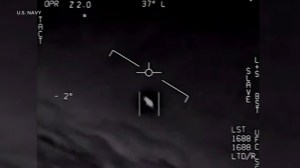
A screenshot taken of a Defense Department video released as part of an investigation by the Unidentified Aerial Phenomena Task Force. (Department of Defense video) 
Secretary of Defense Pete Hegseth provides remarks at a defense company during the Arsenal of Freedom Tour in Louisville, Colo., Feb. 23, 2026. (DoW photo by U.S. Air Force Staff Sgt. Madelyn Keech)
Latest Podcasts

How the Navy is reducing workforce friction to improve mission outcomes

How DARPA is looking to AI to fend off cyber vulnerabilities through a challenge program

How the DOD protects national security interests by monitoring climate change

Scott Kupor: What the Government Can Learn from Silicon Valley on Managing Tech Talent
Tech
- A first, Marines launch FPV drone at unmanned vessel while aboard naval craft
- Pentagon brass tout destruction of Iran’s drone arsenal, but questions linger about what’s left
- U.S. deployed ‘armada’ with more than 150 aircraft to recover downed aviator in Iran
- Pentagon requests more than $20B for strategic capital loan program in 2027
AI
- Feinberg’s new Maven directive sets AI-enabled decision-making as ‘the cornerstone’ for CJADC2
- Chandra Donelson departs as Space Force CDAO
- Army tests autonomous strike drone featuring AI-enabled targeting capabilities
- Pentagon preparing for drone swarm ‘crucible’
Weapons
- Army looks to quadruple procurement for Precision Strike Missile in 2027
- Centcom commander says ‘hundreds’ of U.S. drones are involved in Iran war
- Air Force wants almost $1B to buy first CCA drones in 2027
- Pentagon eyes ‘more and more bunkers’ and other tech to shield troops in Operation Epic Fury
Cyber
- Commanders now responsible for cybersecurity training after Army cuts online course requirement to once every 5 years
- ‘The fight is on’ as top cyber officials try to revamp the military’s digital workforce
- DOD Cyber Crime Center official warns industry about AI-boosted cyberattack ‘kill chain’
- Watchdog urges DOD to address external factors affecting CMMC implementation
 Close Ad
Continue to DefenseScoop